Warm or Weak Airflow
Low airflow may come from a loaded filter, blower trouble, duct restriction, frozen evaporator coil, or a problem with system controls. Testing separates an airflow fault from a refrigeration issue.
Serving Dallas, Texas & surrounding areas
24/7 Emergency Response
Clear diagnostics and practical repairs for cooling systems that blow warm air, run constantly, leak, freeze up, or stop working.

When the house will not cool during a North Texas summer, waiting can make an uncomfortable situation worse. Bold HVAC Dallas provides air conditioner repair Dallas homeowners can use for sudden breakdowns, weak airflow, uneven temperatures, unusual noises, water leaks, and systems that repeatedly cycle on and off.
A good repair starts with testing, not assumptions. Our work as a HVAC service company Dallas homeowners rely on centers on identifying the failed part and checking what caused it to fail. That means examining the thermostat, electrical components, refrigerant circuit, airflow, condensate drainage, indoor equipment, and outdoor unit as the symptoms require. You receive an explanation of the findings and a practical repair plan before work moves forward.
Dallas heat puts long operating hours on cooling equipment. Cottonwood lint, grass clippings, and ordinary outdoor debris can restrict a condenser coil, while a clogged filter or dirty evaporator coil can reduce indoor airflow. These problems make diagnosis especially important because replacing one damaged component without correcting the underlying restriction may lead to another service call.
Low airflow may come from a loaded filter, blower trouble, duct restriction, frozen evaporator coil, or a problem with system controls. Testing separates an airflow fault from a refrigeration issue.
A failed capacitor, contactor, thermostat, disconnect, control board, motor, or power supply can keep an air conditioner off. Electrical measurements help identify the fault safely.
An air conditioner that starts and stops too often may have a control problem, airflow restriction, overheating component, refrigerant issue, or equipment-sizing concern.
A blocked condensate drain, damaged pan, failed drain safety switch, or frozen coil can lead to water near an air handler or furnace. The moisture source should be corrected before nearby materials are damaged.
Grinding, rattling, buzzing, and squealing can point to loose hardware, electrical trouble, or a worn motor. Musty odors may indicate standing condensate or buildup around the indoor coil.
Hot rooms can result from poor airflow, duct leakage, thermostat location, insulation differences, or reduced equipment capacity. Temperature and airflow checks help narrow the cause.
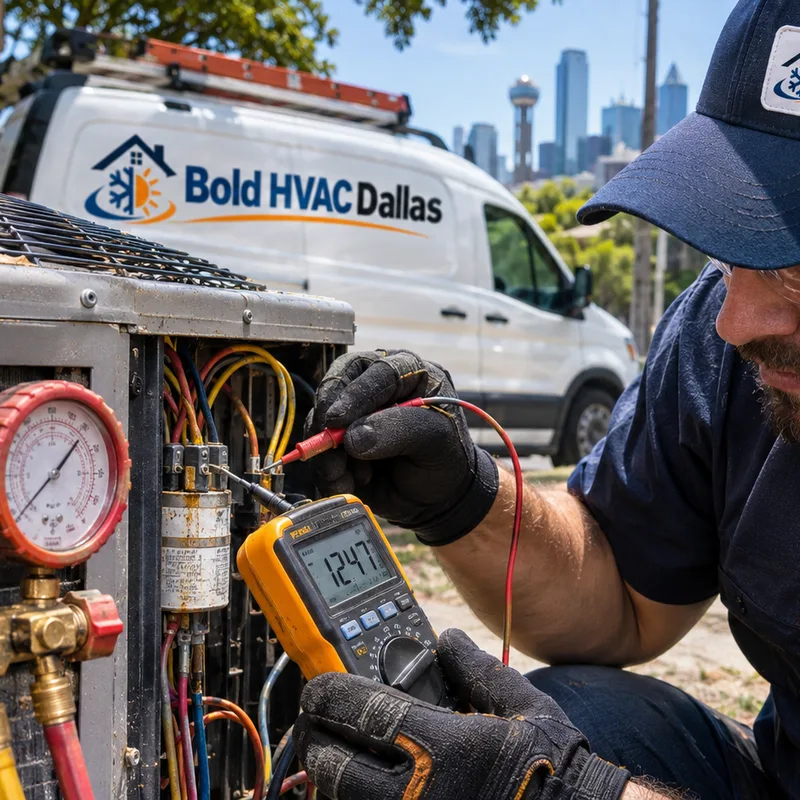
The diagnostic process follows the evidence presented by the system. A technician may verify the thermostat call, inspect the air filter, measure temperature change across the indoor coil, test capacitors in microfarads, check motor amperage, inspect contactors, and assess refrigerant pressures and line temperatures. Superheat and subcooling readings can help evaluate refrigerant performance when system conditions allow.
Refrigerant does not get used up during normal operation. If charge is low, the sealed system may have a leak that needs to be located rather than repeatedly topped off. Ice on the copper line or evaporator coil can also come from poor airflow, so the equipment should be allowed to thaw before certain tests provide useful results.
Dallas includes many different building types. Older homes in Oak Cliff may have additions or altered ductwork that affect room-to-room airflow. Lakewood homes can combine older construction with upgraded mechanical systems, making equipment compatibility worth checking. Uptown condominiums may have limited equipment access or building procedures that affect scheduling. In newer Far North Dallas homes, zoning controls and communicating thermostats can add another layer to diagnosis. Each condition changes how the problem is investigated, not the basic standard for a sound repair.
Share what the system is doing, when the problem began, whether any breakers tripped, and whether ice, water, noise, or odor is present. Those details help focus the initial inspection.
The technician checks the components related to the complaint and records relevant readings. Testing may include electrical measurements, temperature readings, airflow observations, drain inspection, and refrigerant-circuit evaluation.
You receive a plain explanation of the fault, the recommended repair, and any related condition that should be addressed. If equipment age or repair scope makes replacement worth considering, that option can be discussed without disguising it as a required repair.
After approval, the specified work is completed. The system is then operated and checked to confirm that the repaired component works and that cooling performance is consistent with current conditions.
Air conditioning repair in Dallas typically costs about $150 to $1,500, while compressor, coil, refrigerant-leak, or major control repairs can cost more. A basic electrical component or drain correction is generally at the lower end; motors and complex sealed-system work fall higher.
Final price depends on the failed part, equipment type, refrigerant, access, diagnostic time, warranty status, and whether related damage must be corrected. Some systems also require specialty or manufacturer-specific controls. The exact cost is confirmed after the service visit identifies the fault and defines the repair.
A failed part does not automatically mean the entire air conditioner needs replacement. Many problems can be corrected with a capacitor, contactor, motor, drain, sensor, thermostat, wiring repair, or refrigerant-system service. The decision depends on the condition of the complete system, availability of compatible parts, repair cost, prior breakdowns, and whether the equipment can deliver dependable cooling after the work.
Age alone is not a diagnosis. A relatively new system can suffer a serious failure, while older equipment may still justify a straightforward repair. The useful question is whether the proposed work addresses the confirmed fault and leaves the system in reasonable operating condition.
Refrigerant type can influence the decision. Older equipment may use R-22, which is no longer produced or imported in the United States for routine supply. Existing recovered or reclaimed R-22 may still be used, but price and availability can make a major sealed-system repair less practical. Equipment using newer refrigerants has different service requirements, and refrigerants must never be mixed.

If your air conditioner is struggling, arrange a diagnostic visit before extended operation turns a small fault into a larger repair.
Call to ScheduleMany common repairs can be completed during the initial visit when the correct part is available. Timing depends on access, diagnostic findings, equipment model, and whether the work involves a standard electrical part or a major component. During periods of sustained North Texas heat, demand and parts availability may affect scheduling.
Turn the system off if you see ice, smell burning, hear harsh mechanical noise, notice water near electrical equipment, or find that a breaker repeatedly trips. Continuing to run it may damage a motor, compressor, or surrounding materials. If airflow is normal and there are no warning signs, record the thermostat setting and indoor temperature for the technician.
Warm air can result from an incorrect thermostat setting, a tripped outdoor-unit circuit, failed capacitor or contactor, dirty coil, low refrigerant charge, compressor problem, or loss of indoor airflow. Dallas outdoor temperatures can expose marginal components because the system runs longer, but measurements are needed to identify the actual cause.
A frozen coil must usually thaw before complete diagnosis is possible. Turn cooling off and set the fan to run only if it operates normally and there is no water or electrical hazard. Once thawed, the technician can check filters, blower performance, coil condition, duct restrictions, and the refrigerant circuit.
Refrigerant is typically priced according to the type and amount required, and leak diagnosis or repair may be separate. Refrigerant should be added only after the system is evaluated. R-22 systems can carry higher material costs because new production and import ended in the United States, leaving reclaimed supply for service.
Repair is often reasonable when the fault is isolated, compatible parts are available, and the rest of the system is in serviceable condition. Replacement deserves consideration when a major component has failed, the equipment has recurring problems, compatible parts are difficult to obtain, or the repair cost is high relative to the system's likely remaining life.
They sometimes do because equipment may be in a ceiling space, closet, roof area, or shared mechanical location. Uptown and Downtown Dallas properties may also require parking coordination, access approval, elevator scheduling, or building-management notice. Providing those details when arranging service helps prevent delays.
Tell Bold HVAC Dallas what your air conditioner is doing, and get a diagnostic plan focused on the actual fault, practical repair options, and dependable operation.