Industrial HVAC service in Dallas

Industrial HVAC Dallas Services

Installation, repair, and planned maintenance built around your facility, operating schedule, and equipment requirements.

✓Installation and replacement ✓Diagnostics and repair ✓Planned maintenance
Commercial HVAC technicians inspecting large rooftop units on an industrial facility in Dallas

Industrial HVAC Support Built Around Your Operation

Industrial HVAC Dallas work starts with the demands of the building, not a one-size-fits-all equipment recommendation. Bold HVAC Dallas evaluates capacity, operating hours, process heat, ventilation, controls, equipment condition, and service access before proposing work. That approach supports dependable cooling during North Texas heat and helps prevent a repair from creating another problem elsewhere in the system.

Our HVAC service crew throughout Dallas handles industrial heating, cooling, ventilation, and controls with attention to uptime and safe access. We work with facility managers, property teams, owners, and contractors to establish the problem, document the scope, and coordinate around production or occupancy. Whether the need is a new installation, a recurring fault, or a maintenance plan, the work begins with practical system information.

Facility-wide support

Industrial HVAC Services for Dallas Facilities

System Installation and Replacement

Equipment selection begins with load requirements, ventilation needs, available electrical service, controls compatibility, redundancy goals, and roof or mechanical-room access. The scope may include packaged rooftop units, split systems, air handlers, make-up air equipment, exhaust systems, chillers, boilers, or related controls when appropriate to the facility.

Diagnostics and Repair

Troubleshooting may include checking refrigerant pressures and temperatures, electrical components, motors, belts, bearings, safeties, sensors, control sequences, and airflow. The goal is to identify the failed component and determine whether another condition caused the failure.

Preventive Maintenance

Planned service can include filter and belt replacement, coil inspection and cleaning, drain service, electrical checks, lubrication where required, control verification, and operating-condition records. Tasks and frequency should match the equipment type, environment, runtime, and manufacturer requirements.

Controls and System Performance

Incorrect setpoints, failed sensors, poor scheduling, and simultaneous heating and cooling can waste energy or leave spaces unstable. Controls testing checks whether equipment stages, economizers, dampers, and occupied schedules respond as intended.

Ventilation and Airflow

Industrial comfort depends on more than supply-air temperature. Technicians assess fan operation, static pressure, outdoor-air delivery, exhaust, make-up air, duct condition, and distribution issues that can create hot zones or pressure problems.

Equipment Condition Planning

A condition review helps separate immediate repairs from work that can be budgeted. Age, refrigerant type, heat-exchanger condition, compressor history, parts availability, and the operational cost of downtime all affect repair-versus-replacement decisions.

Dallas operating conditions

Industrial HVAC Dallas Conditions Require Careful Planning

Dallas summers place sustained demand on cooling equipment, especially on roofs exposed to direct sun. High outdoor temperatures can reveal dirty condenser coils, weak capacitors, failing motors, low airflow, and controls that are not staging equipment correctly. Maintenance before peak cooling demand gives teams more time to address worn components and access issues.

Facility type matters as much as weather. Distribution and industrial properties in areas such as Stemmons Corridor often have large roof areas and multiple packaged units, so unit identification and roof-access planning are part of efficient service. Properties near the Dallas Design District may combine showrooms, offices, storage, or production areas with different schedules and load profiles. Downtown Dallas buildings can add loading, parking, and restricted work-window considerations. In every case, technicians should confirm site conditions rather than assume that equipment serving two nearby facilities operates under the same demands.

Utility coordination may also affect larger replacements or electrical changes. Oncor is the electric delivery utility for much of Dallas, while the customer's chosen retail electric provider handles the electricity plan. Any utility, permitting, engineering, or inspection requirement should be identified during planning rather than after equipment has been ordered.
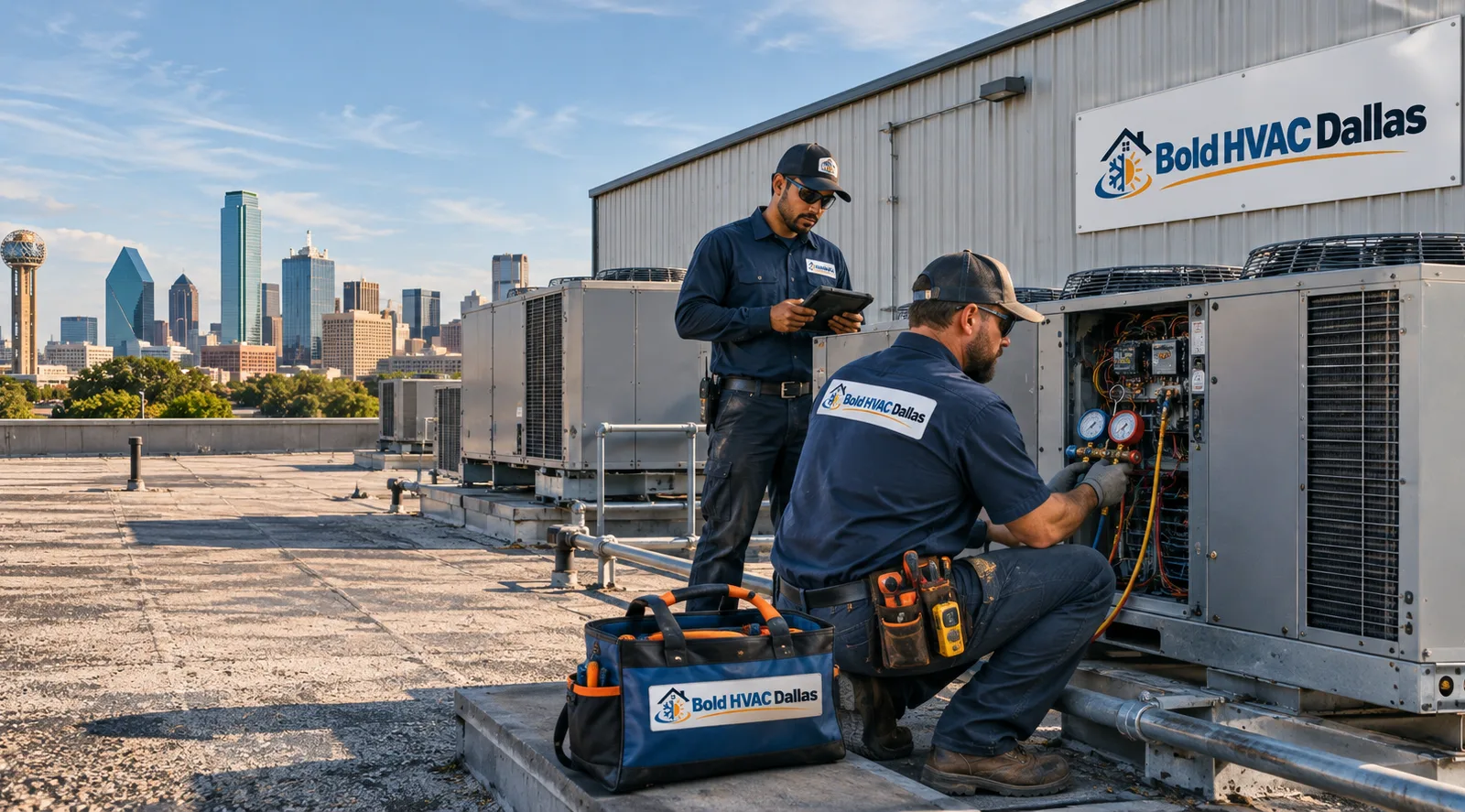

Technician on a Dallas industrial rooftop recording operating readings from a bank of packaged HVAC units
Site conditions, operating schedules, and measured performance shape the service plan.
From review to documentation

How an Industrial HVAC Project Moves Forward

Check Availability
01

Facility and Equipment Review

The technician confirms the affected area, equipment identification, operating complaint, work restrictions, service history, and required access. For installation work, the review also covers loads, ventilation, utilities, curbs, piping, drainage, duct connections, and controls.

02

Testing and Scope Development

Measurements replace assumptions. Depending on the system, testing may include temperature split, static pressure, amperage, voltage, refrigerant conditions, combustion checks, sensor readings, and control commands. Findings are used to define the work and note any limitations.

03

Work and Coordination

The team coordinates shutdowns, deliveries, roof access, lifts, crane activity, and occupied-area protection when those items apply. Components are repaired or installed according to the approved scope, with attention to manufacturer requirements and applicable codes.

04

Startup and Verification

After the work, technicians verify operation under available conditions. Startup can include rotation checks, airflow review, temperature readings, safety testing, staging, setpoint confirmation, and communication with building controls.

05

Documentation and Next Actions

The facility contact receives a clear account of completed work, observed conditions, and recommended follow-up. This helps the maintenance team distinguish urgent items from longer-term capital planning.

Practical capital planning

Repair, Replacement, or a Phased Plan?

A failed industrial unit does not automatically require replacement. A repair may be reasonable when the equipment is otherwise serviceable, the failed part is available, and the system still meets the facility's load. Replacement deserves closer consideration when breakdowns repeat, major components are deteriorated, capacity no longer matches operations, or compatible parts and refrigerant are difficult to obtain.

The decision should also account for business risk. A unit serving a lightly used storage area has a different priority than equipment protecting occupied offices, temperature-sensitive materials, or a production process. Where downtime carries a high cost, a phased replacement plan or temporary cooling strategy may be more practical than waiting for a complete failure.

Capacity should be established through load information rather than matching an old nameplate by default. Building use, envelope changes, added process equipment, outdoor-air requirements, and internal heat gains may have changed since the original system was selected. Oversized equipment can short-cycle and control humidity poorly, while undersized equipment may run continuously without maintaining the target condition.

Useful service records

What Good Preventive Maintenance Should Record

Industrial HVAC maintenance is most useful when it produces a service history, not merely a completed checklist. Records should identify each asset and capture conditions that can be compared over time. Examples include motor amperage, belt condition, temperature readings, filter condition, coil cleanliness, drain performance, contactor wear, sensor accuracy, and active fault codes.

The plan should reflect the site. Equipment exposed to dust, grease, fibers, or heavy outdoor-air loads may need different inspection intervals than units serving cleaner office areas. Filters must have the correct dimensions and pressure characteristics for the system. Coil cleaning methods should suit the coil material and contamination, and electrical work should follow the facility's safety and lockout procedures.

Seasonal visits can prepare cooling equipment before sustained hot weather and check heating components before colder conditions. For sites with many assets, consistent naming and location records reduce time spent finding the correct unit during an outage.

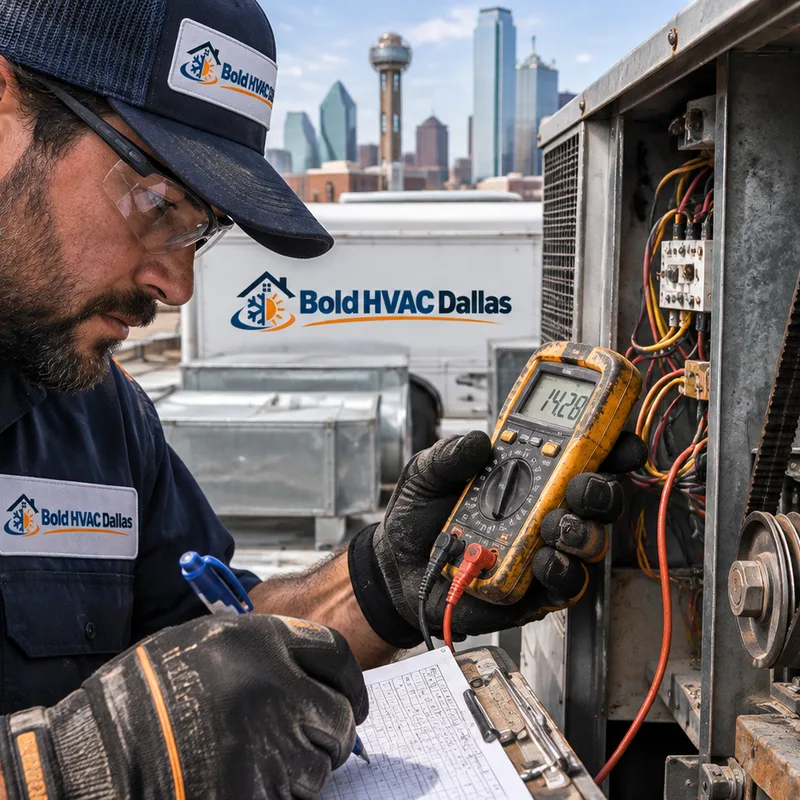
Industrial HVAC technician documenting electrical readings and belt condition inside a rooftop unit
Consistent operating records make developing conditions easier to identify over time.

Bring recurring failures, uneven temperatures, aging equipment, or a planned facility change to Bold HVAC Dallas for a documented assessment and a practical scope of work.

Call to Schedule
Helpful answers

Industrial HVAC Dallas Questions

How much does industrial HVAC service cost in Dallas?+

Industrial HVAC pricing depends on equipment type, capacity, access, diagnostic time, parts, controls, and whether lifting equipment or a crane is required. A service visit involving routine diagnostics costs far less than compressor work, a controls retrofit, or replacement of a large packaged unit. After inspecting the equipment and site conditions, Bold HVAC Dallas can define the work and confirm pricing for the specific facility.

How quickly can an industrial HVAC problem be diagnosed?+

Many common faults can be isolated during the initial visit, but complex controls, intermittent failures, inaccessible equipment, or unavailable parts may extend the process. A Dallas rooftop unit with a straightforward electrical fault is different from a multi-zone system whose problem appears only under full load. Providing asset information, fault history, access instructions, and recent building-control alarms can shorten diagnostic time.

Can HVAC work be scheduled around production or occupied hours?+

Yes, work can often be planned around operating constraints when the restrictions are identified before scheduling. The plan may include staged shutdowns, isolated work areas, after-hours access, or temporary conditioning. Projects involving cranes, roof access, electrical shutdowns, or building automation changes require additional coordination with the facility team and other trades.

What information is needed for an industrial HVAC replacement quote?+

A useful replacement scope requires equipment data, service-area use, operating schedule, known comfort or process problems, available utilities, controls requirements, and access conditions. Nameplate photographs and service records help, but field verification is still necessary. Larger Dallas projects may also require load calculations, engineering, permitting, utility coordination, or structural review depending on the work.

How often should industrial HVAC equipment receive maintenance?+

Maintenance frequency should follow manufacturer guidance and reflect runtime, equipment type, environmental exposure, and the consequences of failure. A unit operating continuously in a dusty industrial area may need attention more often than equipment serving a clean office on a limited schedule. The right plan assigns tasks by asset and season instead of applying one interval to every unit.

Can an industrial HVAC contractor help reduce hot and cold areas?+

Yes, but the cause must be measured before equipment is changed. Uneven conditions can result from duct restrictions, closed dampers, poor balancing, failed sensors, control scheduling, inadequate return air, exhaust imbalance, or changes in space use. Dallas heat can expose marginal airflow and capacity problems, so testing should include both equipment operation and air distribution.

Do industrial HVAC replacements require permits in Dallas?+

Many equipment replacements and mechanical alterations may require permits and inspections through the City of Dallas, depending on the scope and jurisdiction. Electrical, gas, structural, or crane-related work can introduce additional requirements. The project scope should identify the applicable authority and requirements before installation begins, especially when the facility is outside Dallas city limits but within the wider metro area.

Plan the next step

Plan Your Industrial HVAC Work With Clear Information

Describe the equipment, facility use, current problem, and operating constraints. Bold HVAC Dallas will help establish the next step, whether that is diagnostics, planned maintenance, repair, or a replacement assessment.