Relevant Texas Credentials
Ask whether the contractor holds the appropriate Texas Air Conditioning and Refrigeration license for the proposed work. Confirm current insurance and ask who will perform the installation or repair.
Serving Dallas, Texas & surrounding areas
24/7 Emergency Response
Compare qualifications, written estimates, equipment options, and service plans before choosing a heating and cooling contractor for your property.

Choosing among HVAC companies in Dallas takes more than comparing the first price each contractor gives you. A dependable estimate should identify the equipment, labor, controls, permits when required, warranty terms, and any ductwork or electrical changes included in the scope. It should also explain what is excluded.
Bold HVAC Dallas helps property owners assess repair, replacement, installation, and maintenance needs before committing to work. When evaluating each property, Dallas' trusted HVAC service team inspects the system, discusses practical options, and prepares a clear scope based on the property rather than pushing a one-size-fits-all recommendation.
Local conditions matter. Long periods of high summer heat place sustained demand on air conditioners, while winter cold snaps make dependable heating important. Humidity control, airflow, insulation, and duct leakage can also affect comfort. A qualified HVAC company in Dallas should consider the whole system instead of judging equipment by age alone.
Ask whether the contractor holds the appropriate Texas Air Conditioning and Refrigeration license for the proposed work. Confirm current insurance and ask who will perform the installation or repair.
Replacement equipment should not be selected only by matching the old unit's nominal tonnage. A contractor can use Manual J load calculations and property details to estimate heating and cooling demand.
The estimate should state the system type, capacity, efficiency ratings, model information, thermostat, labor, disposal, startup procedures, and warranty coverage. Compare scope before comparing totals.
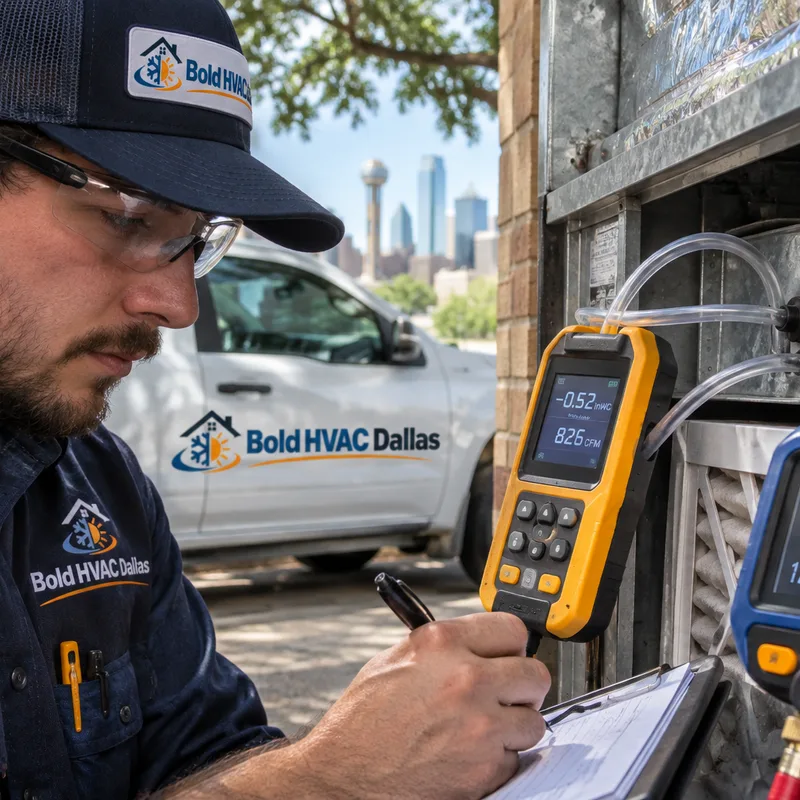
Static pressure, return-air capacity, supply airflow, filter restrictions, and duct condition can expose problems that new equipment alone will not correct.
After installation, technicians should verify refrigerant charge, electrical operation, temperature change, condensate drainage, airflow, controls, and safe startup.
Ask who handles warranty claims, how service appointments are scheduled, and what maintenance the manufacturer requires. Written answers make future responsibilities easier to understand.
Dallas properties do not all present the same HVAC challenges. Historic homes in Swiss Avenue may have limited mechanical space or older duct routes that deserve careful inspection. Oak Lawn includes condominiums and multifamily buildings where equipment access, shared structures, and association requirements can affect scheduling. Downtown Dallas has high-rise and commercial properties that may require building coordination and controlled access. Lake Highlands includes detached homes where attic ductwork and equipment placement can materially affect service conditions.
The type of job matters too. A diagnostic repair requires sound testing and a clear explanation of the failed component. A full replacement calls for capacity selection, equipment compatibility, airflow review, code compliance, and commissioning. Commercial work may involve rooftop units, curb compatibility, crane coordination, economizers, or building controls.
Ask each Dallas HVAC company whether it regularly handles your property type and system. Experience with split systems, heat pumps, furnaces, packaged units, ductless mini-splits, and rooftop equipment is useful only when it matches the work you need.

Write down comfort symptoms, unusual sounds, odors, water near the unit, high utility use, thermostat behavior, and any recent repairs. Note which rooms are affected and when the problem occurs.
A contractor should inspect relevant indoor and outdoor components before quoting major work. For replacement, expect questions about floor area, windows, insulation, occupancy, ductwork, and comfort concerns.
Place estimates side by side and check equipment specifications, labor, permits, accessories, duct modifications, electrical work, disposal, commissioning, and warranties. A low total may cover less work.
The contractor should explain whether repair remains reasonable, why a particular capacity was proposed, and how airflow or duct issues will be addressed. Clear reasoning is more useful than a sales label.
Before work starts, confirm scheduling, property access, payment terms, equipment availability, cleanup, inspection responsibilities, and warranty registration. Keep the signed scope and model information.
HVAC service in Dallas typically costs about $100 to $300 for a diagnostic visit, while common repairs may run $200 to $1,500. Full residential system replacement often ranges from about $7,000 to $18,000 or more, depending on equipment and scope. Final pricing changes with capacity, efficiency, system type, refrigerant work, attic access, duct repairs, controls, electrical upgrades, and permits. Commercial systems and major duct modifications require separate evaluation. The exact cost is confirmed after an on-site inspection and written estimate.
Check AvailabilityStart with licensing, insurance, and responsibility. Ask for the contractor's legal business name and applicable Texas license information, then verify the details through the Texas Department of Licensing and Regulation. Confirm who pulls required permits and who will be present for inspections. Equipment installations may also need to comply with locally adopted mechanical, electrical, energy, and fuel-gas requirements.
Next, examine the technical proposal. Ask whether the indoor and outdoor units are an approved matched system, which efficiency ratings apply, and whether existing line sets, drain lines, disconnects, thermostat wiring, filter cabinets, and ducts are suitable. For heat pumps, ask how auxiliary heat is controlled. For gas furnaces, ask how venting and combustion safety will be checked.
Oncor is the electric delivery utility for much of Dallas, while customers may buy electricity from a retail provider. Equipment incentives and eligibility can change, so verify current requirements directly with the relevant program before assuming a rebate will apply. A trustworthy HVAC company in Dallas, TX, will distinguish a possible incentive from a guaranteed discount.
Finally, read warranty terms carefully. Manufacturer parts coverage, contractor labor coverage, and maintenance agreements are separate items. Ask who registers the equipment, what maintenance records must be retained, and whether labor, refrigerant, diagnostic time, or after-hours service is excluded.
Get an on-site assessment and a written scope that makes equipment, labor, warranty coverage, and next steps clear before work begins.
Call to ScheduleBe cautious when a contractor recommends full replacement without inspecting the indoor unit, outdoor unit, thermostat, electrical components, drain system, filter, and accessible ductwork. Age can influence a decision, but it does not identify the cause of a current failure.
Avoid vague estimates that list only a system size and total price. You should know the proposed model or equipment class, what labor is included, whether ducts or electrical components will change, and how warranties are divided. High-pressure claims about expiring prices or guaranteed utility savings also deserve scrutiny.
A reputable company will not resist reasonable questions about load calculations, matched equipment, airflow, permits, commissioning, or payment terms. It will explain tradeoffs in plain language. That is a better basis for choosing among top HVAC companies in Dallas than review count or price alone.
Two or three written estimates are usually enough for a planned replacement, provided each contractor inspects the property and quotes a comparable scope. Emergency repairs may not allow that process. Compare equipment matching, capacity method, duct and electrical work, permits, commissioning, labor coverage, and exclusions rather than totals alone.
Verify the contractor through the Texas Department of Licensing and Regulation using the business or license information supplied on the estimate. Check that the license is current and appropriate for the work. You can also request proof of insurance and confirm which licensed contractor is responsible for the Dallas job.
A load calculation is appropriate when equipment capacity is being selected, especially after window, insulation, addition, or layout changes. Manual J accounts for factors such as floor area, orientation, windows, insulation, infiltration, and design conditions. Simply matching old tonnage can repeat an earlier sizing error.
A straightforward residential replacement may be completed in one working day, while duct changes, electrical upgrades, equipment access, permits, or inspections can extend the schedule. Availability also tightens during periods of extreme heat. Ask when equipment is confirmed, what must happen before installation, and when final commissioning will occur.
The highest estimate is not automatically the best, and the lowest may omit necessary work. Compare system specifications, load and airflow analysis, installation details, warranty coverage, and post-installation support. A complete proposal can cost more upfront because it includes corrections that another quote leaves out.
Yes, but the evaluation should extend beyond the thermostat and main equipment. In Dallas homes with attic ductwork, technicians may inspect accessible ducts for leakage, damage, poor routing, inadequate returns, closed dampers, filter restrictions, and insulation issues. Airflow measurements can help separate duct problems from equipment faults.
A useful maintenance visit should include inspection and testing appropriate to the equipment and season. Typical tasks include checking electrical components, temperature operation, accessible coils, filters, condensate drainage, controls, and system condition. Gas heating requires combustion and venting checks, while heat pumps require review of reversing and auxiliary-heat operation.
Tell Bold HVAC Dallas what is happening at your property. We will help define the work, discuss practical choices, and prepare a clear plan for your heating and cooling needs.