Central Air Conditioners
A matched outdoor condenser and indoor evaporator coil can use an existing forced-air system when the ductwork and furnace or air handler are compatible.
Serving Dallas, Texas & surrounding areas
24/7 Emergency Response
Get a properly sized heating and cooling system, a clear installation plan, and workmanship focused on reliable comfort through North Texas heat.
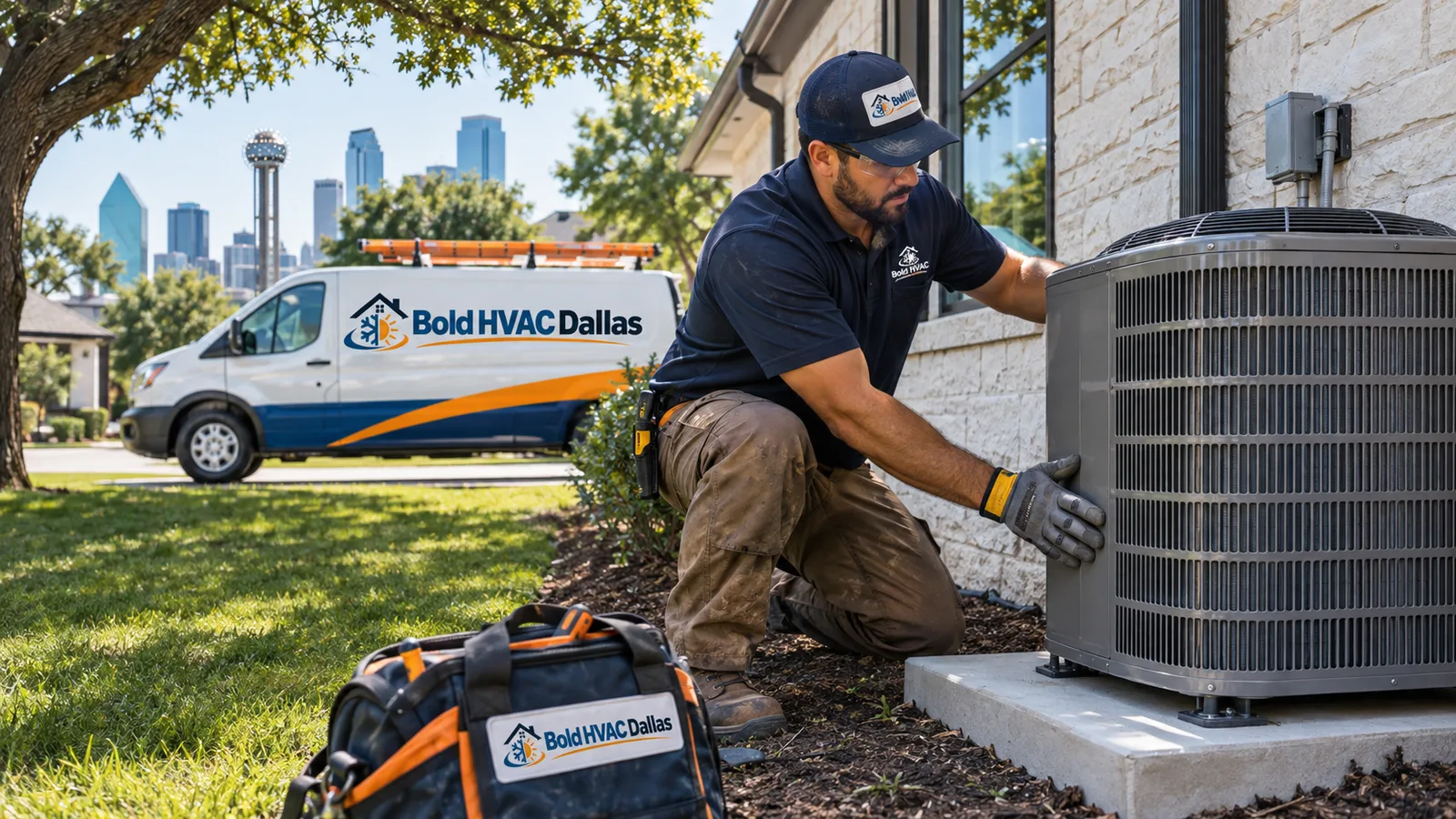
Choosing an HVAC installer in Dallas involves more than comparing equipment brands or efficiency ratings. The contractor should determine how much heating and cooling the property actually needs, inspect the duct system, account for installation conditions, and explain the proposed equipment in plain language. Oversized equipment can cycle too quickly and manage humidity poorly, while undersized equipment may struggle during sustained summer heat.
Bold HVAC Dallas handles this work as an HVAC service company throughout Dallas, TX, with installation planning based on the building rather than a rough equipment swap. We review the existing system, discuss comfort concerns, evaluate electrical and drainage requirements, and prepare a written scope. The goal is a system that fits the property and can be maintained without unnecessary complications.
Dallas conditions make careful planning especially useful. Long periods of high cooling demand put capacity, airflow, condensate drainage, and attic ductwork under pressure. A replacement that ignores those details may run, but it may not deliver balanced temperatures or dependable humidity control.
A sound installation begins with a Manual J load calculation or another appropriate room-by-room evaluation. Square footage alone is not enough. Insulation, window area and orientation, air leakage, ceiling height, occupancy, and heat-producing appliances all affect the load. Equipment selection should then consider matched indoor and outdoor components, available static pressure, and the building's duct capacity.
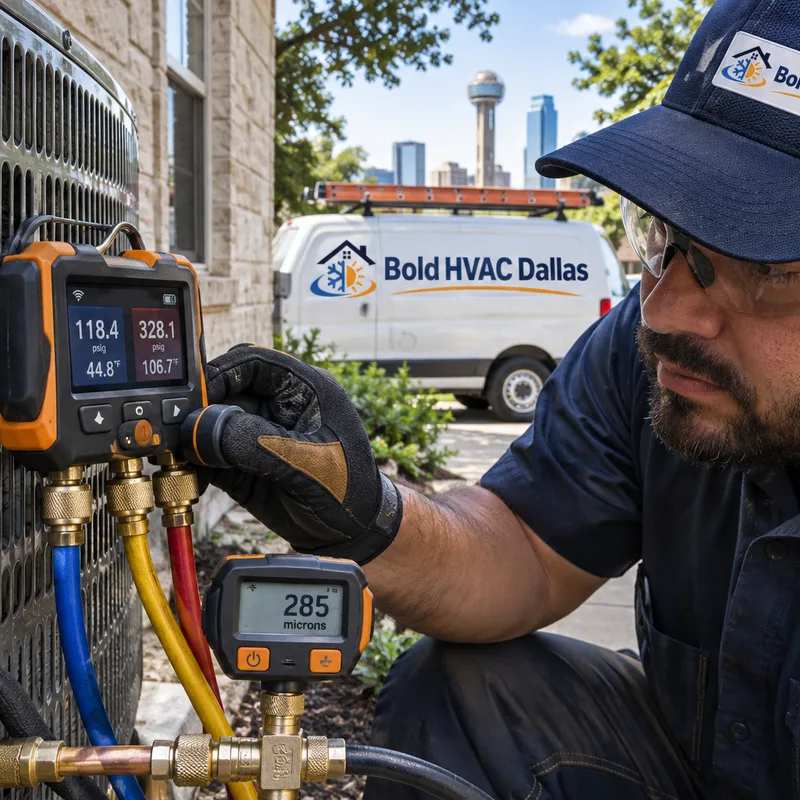
The work may include setting the condenser, installing an evaporator coil or air handler, connecting the refrigerant lines, providing a code-appropriate disconnect, routing condensate drainage, adapting supply and return plenums, and sealing accessible duct connections. Refrigerant lines should be protected from contamination, brazed with nitrogen flowing through the tubing, pressure-tested, evacuated with a micron gauge, and charged according to manufacturer procedures.
Commissioning completes the job. The installer should verify airflow, temperature split, thermostat operation, electrical readings, drain performance, and operating modes. Equipment information and warranty documentation should also be recorded before turnover.
A matched outdoor condenser and indoor evaporator coil can use an existing forced-air system when the ductwork and furnace or air handler are compatible.
A heat pump provides cooling and electric heating through one refrigerant system. Equipment selection should account for winter performance, controls, and any planned auxiliary heat.
Furnace installation requires correct venting, combustion-air provisions, gas connections, electrical work, and an air-conditioning coil matched to the overall system.
Ductless equipment can condition additions, converted spaces, or rooms that lack practical duct access. Placement affects airflow, drainage, appearance, and service access.
Small commercial properties may need rooftop or packaged equipment coordinated with curb dimensions, electrical service, controls, access, and operating schedules.
Compatible controls help the equipment operate as designed. Zoning also requires suitable dampers, bypass or pressure-control planning, and adequate airflow in every operating condition.
We review the existing equipment, accessible ductwork, electrical service, thermostat, refrigerant lines, drainage, and the comfort problems that prompted the project.
The proposed capacity and system type are matched to the building. We also identify duct modifications, line-set needs, access constraints, permits, and other work that belongs in the scope.
You receive a clear description of the selected equipment and included labor. Available efficiency levels and optional changes are separated so you can compare them without confusing allowances.
The old equipment is removed as required, and the new components are set, connected, sealed, pressure-tested, evacuated, and prepared for startup.
We test system operation, drainage, controls, temperatures, and airflow. We then review filter access, thermostat use, maintenance needs, and equipment documentation with you.
A complete residential HVAC installation in Dallas typically ranges from $7,000 to $16,000, while higher-efficiency, variable-capacity, ductless, or extensively modified systems may cost more. A straightforward matched-equipment replacement is generally at the lower end; duct changes, electrical upgrades, zoning, difficult attic access, or multiple indoor units raise the price.
Final cost depends on capacity, efficiency rating, equipment type, controls, permits, refrigerant-line condition, drainage, and the work needed to provide proper airflow. The exact price is confirmed after an on-site assessment and written scope.
Dallas homes and commercial buildings present different installation constraints. Older properties in Oak Cliff may have limited mechanical space, altered duct runs, or electrical systems that need closer review. Lakewood includes older homes where preserving finished areas can affect equipment access and duct modifications. Newer construction in parts of North Dallas may use tighter envelopes, zoning, or more complex controls that require careful commissioning.
Attic installations deserve particular attention across North Texas. High attic temperatures can increase heat gain through poorly insulated or leaky ducts, and cramped access affects how equipment can be set and serviced. Drain pans, primary and secondary condensate paths, float switches, and insulated suction lines should be planned around the actual location.
Dallas permitting and inspection requirements can depend on the property and scope. Equipment efficiency and installation also need to meet applicable federal standards, manufacturer instructions, and adopted local codes. When utility service is relevant, compatibility with the property's electrical supply should be confirmed before equipment arrives.
Ask each contractor how capacity was selected. A proposal based only on the existing unit's nameplate or the property's square footage leaves out insulation, windows, orientation, leakage, and room-by-room needs. A replacement system should not automatically repeat the old capacity because the old equipment may have been incorrectly sized.
Compare complete scopes rather than model numbers alone. The proposal should identify the outdoor unit, indoor coil or air handler, furnace when applicable, thermostat, efficiency ratings, warranty terms, permit responsibility, removal, drain work, electrical changes, duct transitions, startup procedures, and exclusions. Confirm that the indoor and outdoor components form a rated match, commonly documented through an AHRI reference.
Ask who will commission the system and which readings will be checked. Useful answers mention static pressure, airflow, temperature change, refrigerant charging procedures, electrical measurements, thermostat staging, and condensate testing. Also confirm the contractor's licensing and insurance status through the appropriate Texas authorities. A clear process before installation is a good indicator of how the work will be handled once equipment is on the property.
Get a written installation scope based on your property, comfort concerns, and equipment needs before committing to a new system.
Call to ScheduleA straightforward residential equipment replacement can often be completed within one working day, while duct changes, electrical upgrades, zoning, or difficult attic access may extend the work. The schedule should also allow time for startup and commissioning rather than ending as soon as the equipment turns on.
Many HVAC replacement and installation projects in Dallas require permits and inspections, depending on the equipment and scope. The contractor should identify permit responsibility in writing and complete work according to adopted codes, manufacturer instructions, and applicable Texas licensing rules.
Replacing both can make sense when the furnace is aging, the indoor and outdoor components do not form a compatible rated match, or access would make a later replacement costly. If the furnace is serviceable and compatible with the new cooling equipment, it may remain in place after its condition, blower capacity, controls, and heat exchanger are evaluated.
The right efficiency level depends on system type, usage, building condition, budget, and whether the equipment operates at one stage, multiple stages, or variable capacity. SEER2 is used for cooling efficiency, while heat pumps also carry HSPF2 ratings and furnaces use AFUE. Equipment must meet applicable regional and federal requirements.
A new system may improve uneven temperatures only when the cause is addressed. Dallas-area attic ducts may have leakage, inadequate insulation, poor return-air paths, restrictive filters, or incorrect branch sizing. The installer should assess airflow and duct conditions rather than assuming new equipment will correct a distribution problem.
Existing ducts can often be reused if they are correctly sized, reasonably tight, insulated where required, and able to handle the new equipment's airflow. Accessible ducts, plenums, return capacity, filter arrangement, and static pressure should be evaluated before the system is selected.
A useful quote should identify the equipment, matched-system ratings, labor, removal, permits, thermostat, refrigerant-line work, condensate provisions, electrical changes, duct transitions, commissioning, warranties, payment terms, and exclusions. Dallas properties with attic equipment should also have access and drain-protection needs addressed in the scope.
Tell Bold HVAC Dallas about the property and the comfort problems you want to solve. Our team will assess the installation conditions, discuss suitable equipment, and prepare a clear scope for the work.