Commercial HVAC service in Dallas

Commercial HVAC Companies in Dallas

Practical installation, repair, replacement, and maintenance planning for dependable comfort in North Texas commercial buildings.

✓Commercial repair and diagnostics ✓Installation and replacement planning ✓Preventive maintenance support
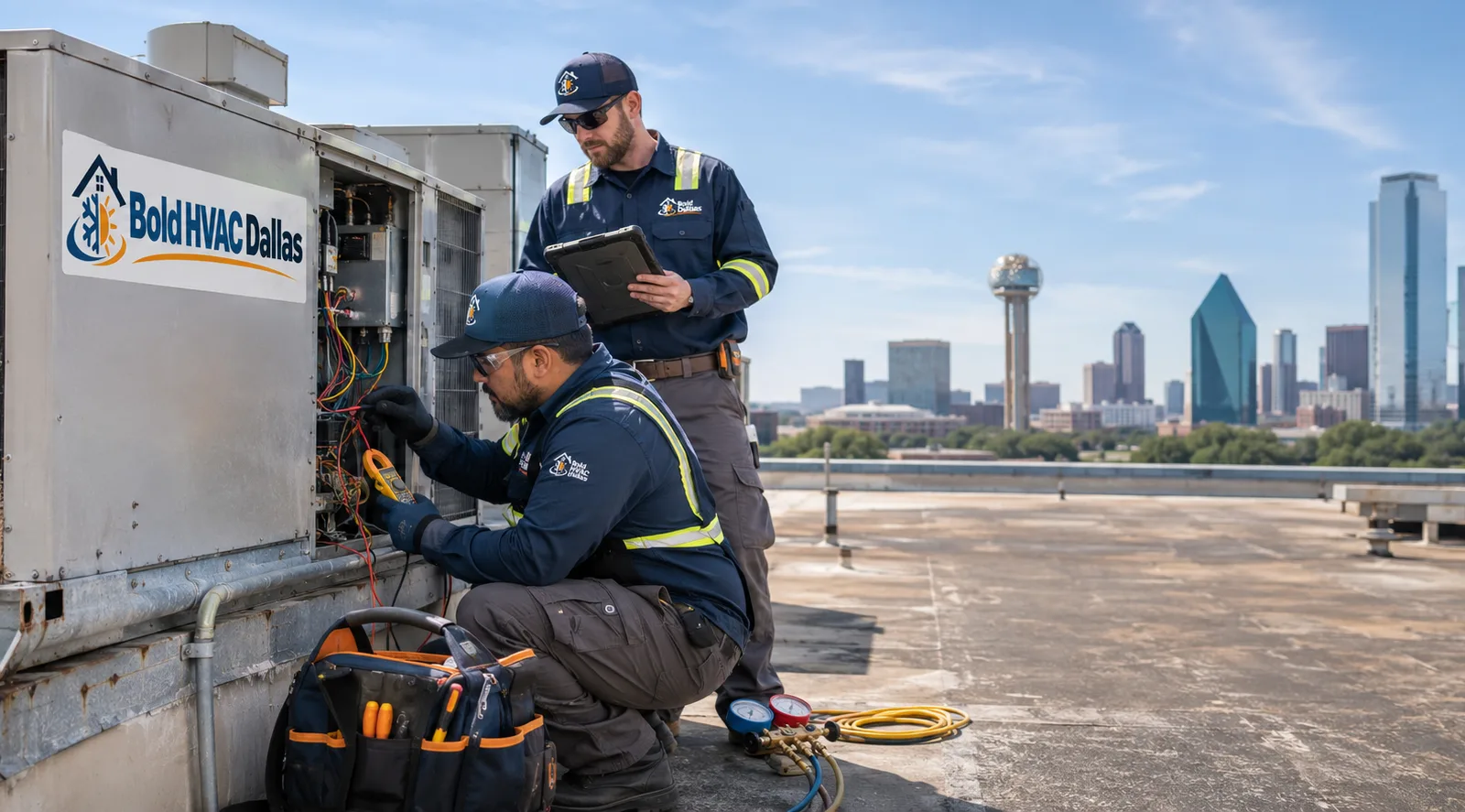
Commercial HVAC technicians inspecting packaged rooftop units on a Dallas office building with safety equipment and service tools

Commercial HVAC Service Built Around Your Facility

Businesses comparing commercial HVAC companies in Dallas need more than a quick equipment recommendation. The right contractor starts with the building, occupancy, operating schedule, existing controls, maintenance history, and comfort complaints. Those details help determine whether the best next step is a repair, a controls adjustment, a planned replacement, or a broader system upgrade.

Bold HVAC Dallas provides commercial HVAC support for offices, retail properties, restaurants, warehouses, and other facilities. Our HVAC service experts in Dallas assess the cause of the problem, explain practical options, and define the work before equipment is ordered or repairs begin. A clear scope should identify the affected unit, proposed work, major equipment or parts, access needs, and any assumptions that could change the price.

Dallas conditions put sustained demand on cooling equipment. Long periods of high outdoor temperatures increase runtime, while rooftop units also face direct sun, windblown debris, and storm exposure. Commercial systems should be evaluated for actual building loads and use patterns rather than selected solely by matching the capacity of old equipment.
Facility-wide support

Dallas Commercial HVAC Capabilities

System Installation and Replacement

Equipment selection should account for calculated load, ventilation, electrical service, curb or pad requirements, duct conditions, controls, and service access. Commercial work may involve packaged rooftop units, split systems, heat pumps, make-up air equipment, or multi-zone systems.

Commercial HVAC Repair

Diagnosis can include electrical testing, temperature and pressure readings, airflow checks, thermostat or building-control review, condensate inspection, and verification of safeties. The goal is to identify the failed component and the operating condition that contributed to it.

Preventive Maintenance

Planned service commonly includes filter replacement, coil inspection, drain cleaning, belt and bearing checks where applicable, electrical inspection, refrigerant-circuit evaluation, and operating-temperature measurements. Tasks should match the equipment and manufacturer guidance.

Controls and Zoning

Poor scheduling, drifting sensors, failed dampers, and incorrect setpoints can create comfort problems even when major equipment still runs. Controls should be tested as part of the whole system rather than treated as an isolated accessory.

Indoor Air and Ventilation Review

Commercial comfort depends on airflow, outdoor-air delivery, filtration, humidity behavior, and pressure relationships. Any recommendation should account for the building's occupancy and intended use.

Replacement Planning

A phased plan can help property managers prioritize aging equipment, coordinate tenant needs, and schedule crane access or shutdowns. It also creates time to compare repair cost, equipment condition, and expected service life.

Contractor evaluation

What to Look for in Commercial HVAC Companies in Dallas, TX

Start by confirming that the contractor carries the licenses and insurance required for the proposed work. In Texas, air-conditioning and refrigeration contracting is regulated by the Texas Department of Licensing and Regulation. Ask who will obtain permits when they are required and how inspections will be coordinated with the authority having jurisdiction.

A useful proposal states equipment model information, capacity, efficiency ratings, controls, warranty terms, exclusions, and the work needed to connect the system. It should also address roof access, crane or lift requirements, electrical changes, curb adapters, duct transitions, condensate routing, and disposal of replaced equipment when those items apply.

Ask how the company verifies performance after installation or repair. Useful closeout checks include supply and return temperatures, static pressure where appropriate, airflow, electrical readings, control sequences, drainage, and refrigerant charge according to manufacturer procedures. A contractor should also explain how occupied areas will be protected and how disruptions will be scheduled.

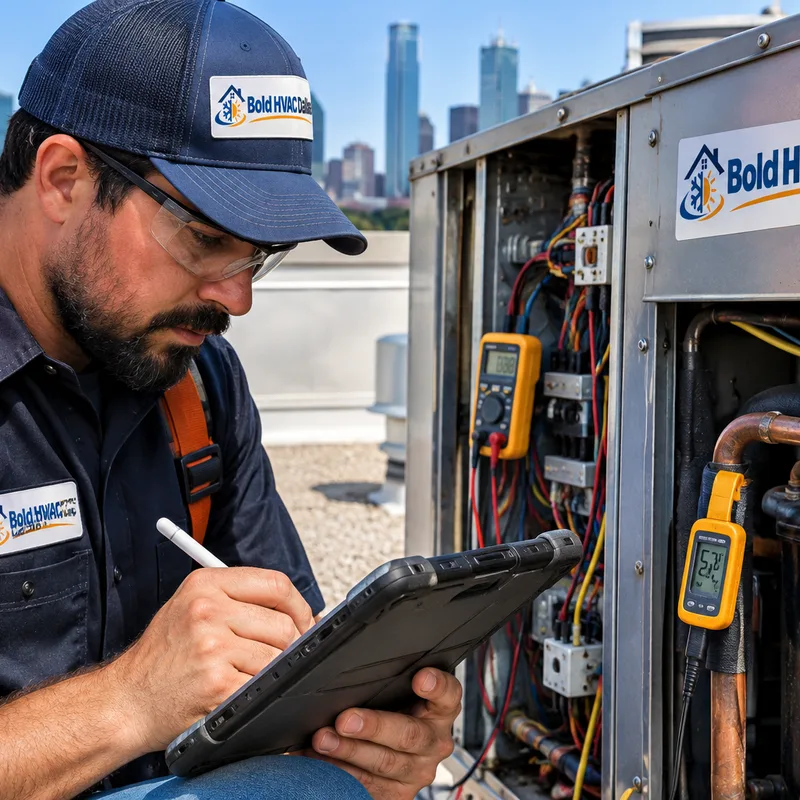
Commercial HVAC technician taking electrical and temperature readings at an open rooftop unit while documenting findings on a tablet
Measured operating data supports a specific diagnosis and a clearer written scope.
Property-specific planning

Commercial HVAC Across Different Dallas Properties

Commercial HVAC in Dallas, TX varies sharply by property type. Downtown high-rises can involve controlled loading areas, roof-access rules, tenant scheduling, and coordination with building management. Deep Ellum's mix of restaurants, entertainment venues, and converted commercial spaces can add kitchen heat, changing occupancy, and limited equipment access to the job plan.

In the Design District, showrooms, studios, warehouses, and offices may place different loads on separate parts of the same property. Preston Center office and retail buildings often need work scheduled around customers and professional tenants. Industrial facilities near the Stemmons Corridor may have large open areas, loading activity, process heat, or ventilation needs that require a zone-by-zone assessment.

These differences affect equipment choice and logistics. A commercial HVAC Dallas contractor should ask about lease responsibilities, occupancy peaks, critical rooms, roof permissions, delivery restrictions, and acceptable shutdown windows before finalizing the scope.

Check Availability
Assessment through commissioning

How a Commercial HVAC Project Should Proceed

Check Availability
01

Document the Building and Complaint

The first visit identifies affected areas, equipment type and condition, control settings, maintenance history, occupancy patterns, and when the problem occurs. Model and serial information should be recorded when accessible.

02

Test the System

The technician checks relevant electrical, refrigeration, airflow, drainage, combustion, ventilation, and control components. Testing should be tailored to the system rather than based on a standard parts list.

03

Present the Scope

The written recommendation distinguishes required work from optional improvements. For replacement projects, it should identify equipment, connection work, access needs, scheduling assumptions, warranties, and exclusions.

04

Coordinate and Complete the Work

Scheduling accounts for occupants, deliveries, roof access, lifts or cranes, weather, and planned shutdowns. Work areas should be protected, and removed components should be handled as stated in the scope.

05

Commission and Document

The completed system is started, tested, and checked through its operating sequence. The facility contact should receive relevant operating information, warranty documents, and recommended maintenance intervals.

Commercial pricing guidance

How Much Does Commercial HVAC Service Cost in Dallas?

Commercial HVAC service in Dallas typically starts around $150 to $500 for diagnosis and minor service, while substantial repairs may range from $1,000 to $10,000 or more. Replacement projects often begin near $8,000 for smaller systems and can exceed $30,000 per unit when capacity, controls, curb work, electrical changes, or crane access are involved.

Final price depends on equipment type, tonnage, refrigerant, parts availability, access, operating condition, permit needs, and work hours. The exact cost is confirmed after an on-site assessment and written scope.

Check Availability
Long-term equipment planning

Repair, Replace, or Plan a Phased Upgrade?

Repair often makes sense when the failure is isolated, replacement parts are available, and the equipment remains suitable for the building. Replacement deserves closer consideration when failures recur, a major component has failed, corrosion or coil damage is extensive, controls are obsolete, or the system no longer supports the property's use.

Age alone should not decide the outcome. Review service history, current condition, refrigerant type, parts support, load requirements, comfort performance, and the cost of an unplanned shutdown. A load calculation may be appropriate when occupancy, layout, glazing, insulation, ventilation, or internal heat loads have changed. Simply copying the old unit's nominal tonnage can repeat an existing sizing problem.

For multi-unit properties, a phased plan can rank equipment by condition and operational risk. That gives owners a basis for budgeting and lets replacement work be coordinated with tenant schedules, roof projects, or electrical upgrades.

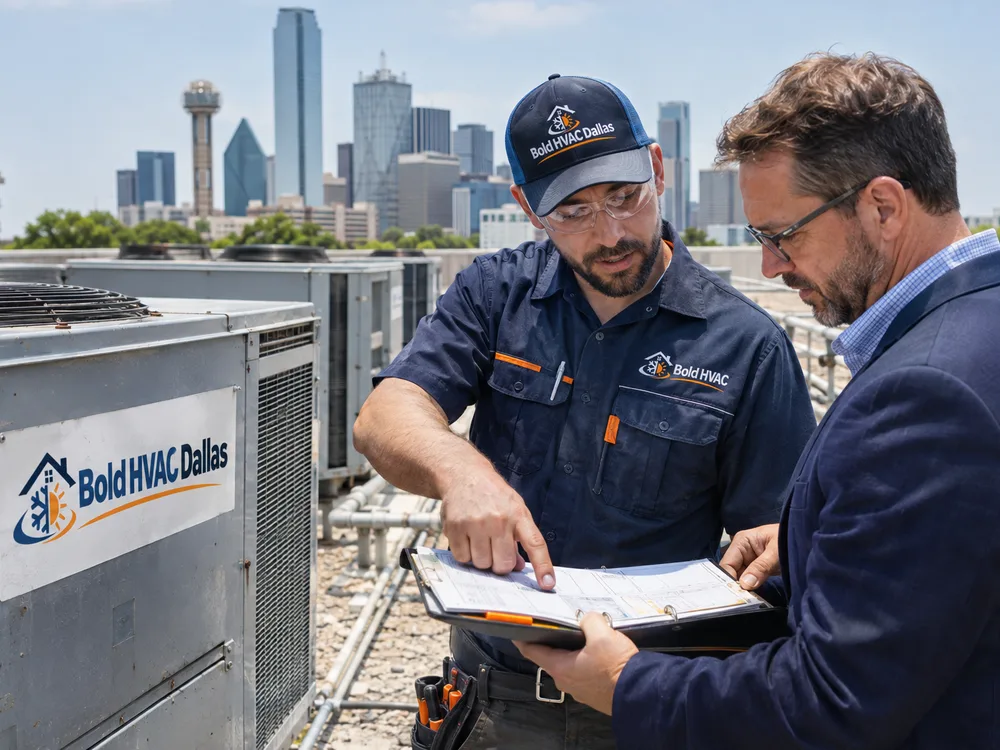
Technician and commercial property manager reviewing rooftop HVAC condition notes and replacement options beside packaged units
Condition, repair history, building load, and operational risk should guide replacement decisions.

Get a documented assessment and a practical scope before committing to a major commercial HVAC repair or replacement.

Call to Schedule
Helpful answers

Commercial HVAC Dallas, Texas FAQs

How quickly can a Dallas commercial HVAC company respond to a cooling failure?+

Response time depends on current demand, technician availability, building access, and the equipment involved. During periods of intense North Texas heat, service demand can increase, so provide the unit location, symptoms, model information, roof-access requirements, and site contact when requesting service. These details help the company prepare for the visit.

How often should commercial HVAC equipment in Dallas be maintained?+

Maintenance frequency should follow the equipment manufacturer's guidance and reflect runtime, environment, filtration needs, and property use. Dallas rooftop equipment may run heavily during extended hot weather and is exposed to outdoor debris. Restaurants, high-occupancy spaces, and facilities with process loads may need more frequent inspection or filter service than lightly used offices.

What should a commercial HVAC replacement proposal include?+

A replacement proposal should identify the equipment, capacity, efficiency rating, controls, warranty, connection work, access plan, exclusions, and commissioning steps. For Dallas rooftop projects, it should also state whether crane service, curb adapters, roof coordination, permits, electrical work, or scheduled shutdowns are included.

Can commercial HVAC work be completed without interrupting business?+

Many projects can be staged to limit disruption, but the plan depends on the system layout and required shutdowns. After-hours work, temporary cooling, phased replacements, and zone-by-zone service may be options. Downtown access restrictions, tenant schedules, crane setup, and property-management rules must be settled before work begins.

Does commercial HVAC work in Dallas require a permit?+

Permit requirements depend on the work and the jurisdiction. Equipment replacement, electrical changes, gas work, and substantial mechanical alterations may require permits and inspections. The proposal should state who handles that process and which authority has jurisdiction over the property.

How do I compare bids from commercial HVAC companies in Dallas?+

Compare the defined scope rather than the total price alone. Confirm that each bid uses comparable capacity, efficiency, controls, warranties, duct or curb work, electrical allowances, access equipment, disposal, permits, startup, and commissioning. A low bid may exclude work another contractor has included.

Should a commercial HVAC system be replaced with the same tonnage?+

The existing tonnage should be verified rather than copied automatically. A load assessment may be needed if the Dallas property has changed occupancy, layout, windows, insulation, ventilation, lighting, or equipment loads. Correct sizing supports temperature control, moisture management, equipment cycling, and service life.

Plan the next step

Plan Your Commercial HVAC Work With Confidence

Tell Bold HVAC Dallas about the property, equipment, and current concern. Our team will arrange the next step and provide a clear scope based on the building's actual needs.